CRYOLOOP vs. Immersion Cooling, Direct-to-Chip, and Conventional Chillers: A Technical Comparison
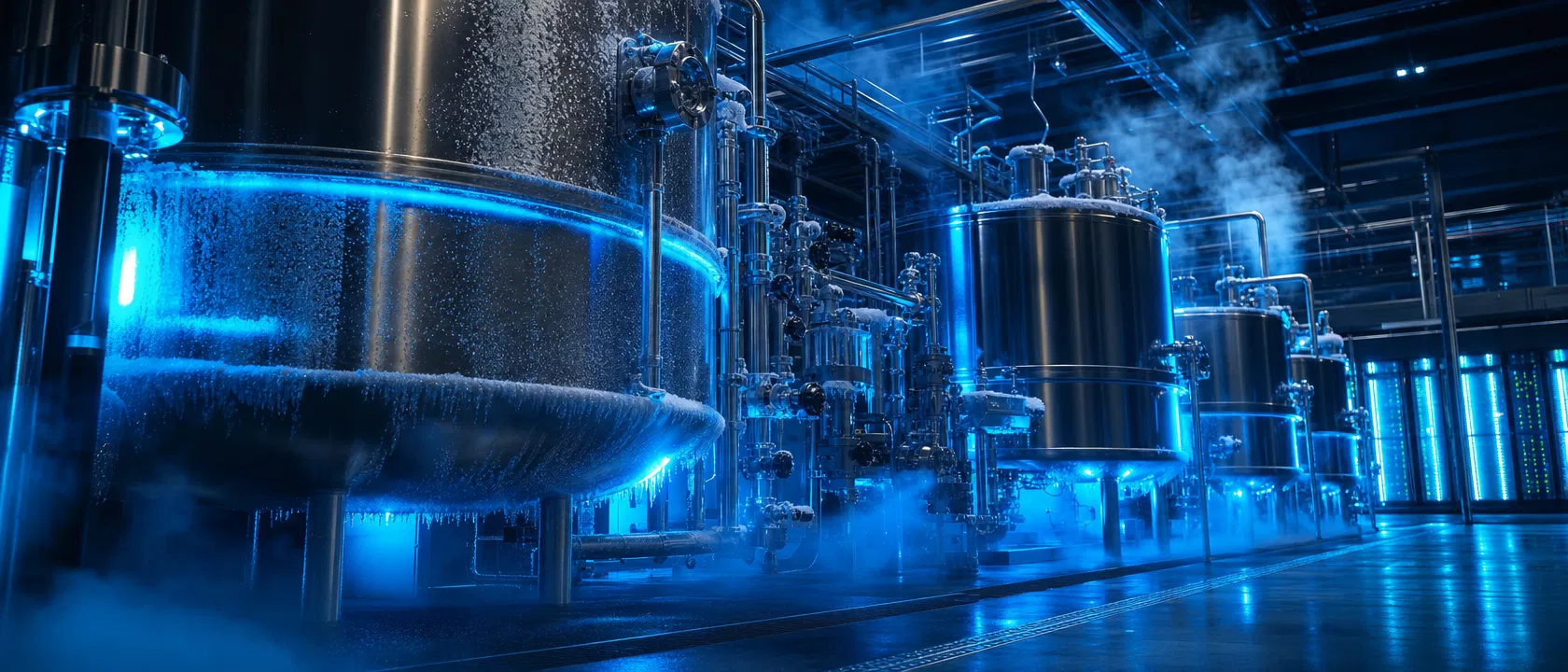
The question we hear most often isn't "what is CRYOLOOP?" — it's "how does it compare to what we're already evaluating?"
Fair question. The data center cooling market is crowded with solutions, each addressing a different layer of the thermal stack. Immersion cooling. Direct-to-chip liquid cooling. Next-generation chillers. Rear-door heat exchangers. They're all legitimate technologies solving real problems.
But they're all solving different problems than CRYOLOOP — and understanding where each technology sits in the cooling architecture is the key to understanding why CRYOLOOP isn't competing with these solutions. It's replacing the thing they all depend on.
The Origin: From -80°C Cannabis Extraction to Data Center Cooling
CRYOLOOP wasn't born in a data center. It was born in a pharmaceutical-grade cannabis extraction lab.
Prodigy Processing Solutions — our parent company — manufactures cryogenic extraction equipment that operates at temperatures as low as -80°C. At those temperatures, you hit a fundamental thermodynamic wall: conventional vapor-compression chillers can't efficiently reach those depths without cascading — literally stacking a chiller on top of a chiller. And the upstream heat rejection? Either a massive compressor bank consuming enormous electricity, or an evaporative cooling tower dumping thousands of gallons of water into the atmosphere every hour.
We needed cold. Deep cold. Without the water waste. Without the electricity penalty. Without the HFC refrigerants that regulators are systematically banning.
So we built a closed-loop liquid nitrogen system that delivers extreme cold through phase-change thermodynamics — no compressors, no cooling towers, no refrigerants. We solved our own problem first.
Then we looked at the data center industry and realized they're hitting the exact same wall. Just at a different scale.
KEY STAT: U.S. data centers consumed approximately 176 terawatt-hours of electricity in 2023 — roughly 4.4% of total U.S. electricity generation. 40% of that goes to cooling alone.
Understanding the Cooling Stack: Where Each Technology Lives
Before comparing technologies, you need to understand the data center cooling architecture as a layered stack:
Layer 1 — Chip/Component Level: Cold plates, thermal interface materials, heat spreaders. This is where heat is generated.
Layer 2 — Rack/Server Level: Immersion baths, rear-door heat exchangers, in-row coolers, direct-to-chip CDUs. This is where heat is captured and transferred to a working fluid.
Layer 3 — Facility/Plant Level: Chiller plants, cooling towers, dry coolers. This is where heat is ultimately rejected to the environment. This is the cold source — the thing that makes everything upstream work.
CRYOLOOP operates at Layer 3. It replaces the chiller plant. Every other liquid cooling technology — immersion, direct-to-chip, rear-door — still needs something at Layer 3 to supply cold fluid. That something is traditionally a chiller consuming 40% of the facility's electricity and millions of gallons of water.
CRYOLOOP vs. Immersion Cooling
BY THE NUMBERS: Immersion cooling achieves PUE of 1.03–1.08 at the rack level, but still requires an upstream chiller plant to cool the dielectric fluid. CRYOLOOP eliminates that chiller plant entirely.
What immersion cooling does: Submerges servers in dielectric fluid (single-phase or two-phase), removing heat at the rack level with exceptional efficiency. Companies like Submer, GRC (Green Revolution Cooling), and LiquidCool Solutions have proven this approach works.
What immersion cooling doesn't do: Reject heat to the environment. The dielectric fluid absorbs heat from the servers, but that heat has to go somewhere. In every immersion deployment, a secondary cooling loop carries heat from the immersion bath to... a chiller. A conventional, electricity-hungry, water-consuming, HFC-laden chiller.
How CRYOLOOP complements immersion cooling: CRYOLOOP can serve as the cold source that feeds immersion baths requiring sub-ambient inlet temperatures. Instead of a chiller plant consuming megawatts of electricity and millions of gallons of water, CRYOLOOP's closed SYLTHERM XLT secondary circuit delivers chilled fluid directly to the immersion system's heat exchanger.
The bottom line: Immersion cooling and CRYOLOOP are not competitors. They operate at different layers of the stack. Together, they represent a fully optimized cooling architecture — immersion for rack-level heat capture, CRYOLOOP for facility-level heat rejection.
CRYOLOOP vs. Direct-to-Chip Liquid Cooling
What direct-to-chip does: Cold plates mounted directly on CPUs and GPUs, with chilled fluid circulating through microchannels. Companies like CoolIT Systems, ZutaCore, and Vertiv offer proven solutions. NVIDIA's GB200 NVL72 racks (120–140 kW per rack) mandate this approach — air cooling simply cannot handle these densities.
What direct-to-chip doesn't do: Cool the entire server. Direct-to-chip handles approximately 75% of the thermal load (the processors), but memory, storage, VRMs, and networking components still require airflow. And critically, the cold fluid feeding those cold plates has to come from... a chiller.
How CRYOLOOP integrates: CRYOLOOP's supercooled transfer fluid feeds directly into CDU (Coolant Distribution Unit) loops that supply cold plates. The CDU doesn't care whether its cold source is a conventional chiller or a CRYOLOOP unit — it just needs cold fluid at the specified temperature and flow rate.
The bottom line: Direct-to-chip is the right answer for rack-level heat capture on high-density AI hardware. CRYOLOOP is the right answer for generating the cold fluid that feeds it — without the electricity penalty, water waste, or HFC exposure of a conventional chiller.
CRYOLOOP vs. Conventional Chiller Plants
This is the direct comparison. CRYOLOOP replaces conventional chillers.
What conventional chillers do: Use vapor-compression cycles (with HFC refrigerants like R-410A, R-134a, or R-407C) to transfer heat from facility water loops to the outdoor environment, typically via cooling towers.
The problems with conventional chillers:
- ●
Electricity consumption: Chillers and their associated cooling towers consume approximately 40% of a data center's total electricity. For a 100 MW facility, that's 40 MW dedicated solely to removing heat.
- ●
Water consumption: Evaporative cooling towers consume staggering volumes. Google's Council Bluffs, Iowa facility alone consumed 1.3 billion gallons of potable water in 2024 — approximately 3.7 million gallons per day from a single campus.
- ●
HFC refrigerant exposure: Under the EPA's AIM Act Technology Transitions rule, data center cooling systems face a GWP (Global Warming Potential) limit of 700, with a compliance date of January 1, 2027. The Kigali Amendment mandates an 85% global HFC phasedown. Every conventional chiller in operation today faces regulatory obsolescence.
- ●
Mechanical complexity: Compressors, condensers, evaporators, expansion valves, cooling tower fans, water treatment systems — hundreds of failure points requiring constant maintenance.
KEY TAKEAWAY: CRYOLOOP is designed to address all four problems. Liquid nitrogen has a GWP of zero. The system is designed for zero evaporative cooling-water consumption. It eliminates compressors and cooling-tower fans from the defined cooling-plant boundary, targeting a reduction in on-site electrical demand. And the mechanical architecture is radically simpler — a storage vessel, a heat exchanger, and a recapture loop.
CRYOLOOP vs. Rear-Door Heat Exchangers and In-Row Cooling
What they do: Passive or active heat exchangers mounted on the back of server racks (rear-door) or between racks (in-row). They intercept hot exhaust air and transfer heat to a chilled water loop.
The dependency: Both require a supply of chilled water. That chilled water comes from... a chiller plant.
CRYOLOOP's role: Serves as the cold source feeding rear-door and in-row units. Drop-in compatible with existing chilled water infrastructure — no rack-level modifications required.
The Regulatory Cliff: HFC Phase-Down and Data Centers
This is the factor most cooling technology comparisons ignore — and it may be the most consequential.
The EPA's AIM Act establishes an 85% phasedown of HFC production and consumption over 15 years. For data centers specifically:
- ●January 1, 2027: New data center cooling systems (CRAC, CRAH, chillers) cannot use refrigerants with GWP above 700
- ●Existing systems: Subject to increasingly stringent leak detection and repair requirements under the HFC Management Rule (effective January 1, 2026)
- ●Long-term trajectory: Available low-GWP alternatives (R-290 propane, R-744 CO₂, R-1234ze) have significant limitations in capacity, flammability, or operating pressure
CRYOLOOP's position: Liquid nitrogen has a Global Warming Potential of exactly zero. It is not a refrigerant under any regulatory framework. CRYOLOOP systems are completely exempt from AIM Act restrictions, Kigali Amendment obligations, and all HFC-related compliance costs. This isn't a marginal advantage — it's a significant long-term regulatory advantage.
Energy, Water, and Regulatory Impact
In practical terms, CRYOLOOP's phase-change approach targets dramatic reductions in cooling-related electricity consumption, eliminates water usage entirely (zero evaporative cooling), and uses nitrogen — a naturally occurring atmospheric gas with zero global-warming potential — instead of synthetic HFC refrigerants that face phase-down under the AIM Act. These characteristics position CRYOLOOP-equipped facilities for compliance with tightening environmental regulations without requiring future retrofits.
The Science: Why Phase-Change Beats Compression
Traditional cooling uses mechanical work (compressors) to move heat against a temperature gradient. This is inherently energy-intensive — you're fighting thermodynamics with brute force.
CRYOLOOP exploits the latent heat of vaporization of liquid nitrogen. When LN₂ transitions from liquid (-196°C) to gas, it absorbs approximately 199 kJ/kg of thermal energy — without any mechanical work input. That phase-change energy is free. The only energy cost is recapturing and re-liquefying the nitrogen vapor for the closed loop.
KEY STAT: CRYOLOOP exploits the latent heat of vaporization of liquid nitrogen — approximately 199 kJ/kg absorbed during phase change — without any mechanical compression work. Rated output and system-level performance are under active measurement during prototype development.
The physics are unambiguous: exploiting latent heat at cryogenic temperatures is fundamentally more efficient than vapor-compression cycling at near-ambient temperatures. CRYOLOOP targets a significant reduction in on-site cooling-plant electrical demand while being designed for zero evaporative cooling-water consumption and zero HFC refrigerant charge within the defined cooling-plant boundary. Validated performance figures will be published following completion of thermal output testing.
Frequently Asked Questions
Does CRYOLOOP work with NVIDIA GB200 and GB300 NVL72 rack architectures?
Yes. NVIDIA's GB200 NVL72 racks operate at 120–140 kW per rack and mandate liquid cooling. CRYOLOOP feeds supercooled transfer fluid into the CDU (Coolant Distribution Unit) loops that supply cold plates on each GPU and CPU. The CDU interface is standard — CRYOLOOP is a drop-in replacement for the upstream chiller that would otherwise supply that cold fluid.
Can CRYOLOOP retrofit into existing data center cooling infrastructure?
Yes. CRYOLOOP connects to existing chilled water distribution infrastructure at the facility level. If your data center currently uses chilled water loops to feed CDUs, rear-door heat exchangers, in-row coolers, or CRAH units, CRYOLOOP can replace the chiller plant without modifying downstream distribution. The transition is at the plant level, not the rack level.
Is CRYOLOOP suitable for edge deployments and modular data centers?
Yes. Because CRYOLOOP eliminates cooling towers, compressor banks, and water treatment systems, its physical footprint is dramatically smaller than conventional chiller plants. This makes it particularly well-suited for space-constrained edge deployments, modular/prefabricated data centers, and locations where water availability is limited or water rights are contested.
What is CRYOLOOP's current development status?
CRYOLOOP is in active prototype development with an industrial fabrication pathway. The system is protected by a PCT patent application (PCT/US2024/056970) with all 19 claims found novel, inventive, and industrially applicable. National phase filings entered May 2026 across six jurisdictions (US, Canada, China, EPO, UK, India). The prototype was engineered and fabricated by MITCO Fabrication & Welding — the same ASME-certified fabrication partner that builds Prodigy's pharmaceutical-grade extraction equipment.
How does CRYOLOOP address the "energy cost of liquefaction" argument?
The energy required to liquefy nitrogen is real — but it's dramatically less than the energy consumed by conventional chiller plants operating 24/7/365. Industrial air separation units (ASUs) produce liquid nitrogen at scale with well-understood economics. In a closed-loop configuration, CRYOLOOP recaptures vaporized nitrogen for re-liquefaction, further reducing the net energy input. The total system energy — including liquefaction — is under active measurement. Conservative component estimates and measured system data will quantify the resulting on-site electrical demand.
How does CRYOLOOP compare to free cooling / economizer modes?
Free cooling (using cold outdoor air when available) is effective in cool climates but is geography-dependent, season-dependent, and humidity-sensitive. It cannot serve facilities in hot climates, and it provides no cooling during summer peaks when demand is highest. CRYOLOOP operates independently of ambient conditions — it delivers the same performance in Phoenix in August as it does in Iceland in January.
The Bottom Line
Every data center cooling technology on the market today — immersion, direct-to-chip, rear-door, in-row — addresses heat capture and transfer at the rack or row level. They're all good at what they do. But they all depend on a conventional chiller plant to actually reject that heat.
CRYOLOOP replaces that chiller plant. It's not competing with rack-level solutions — it's eliminating the infrastructure bottleneck behind them.
Designed for zero evaporative cooling-water consumption. Zero HFC refrigerant charge. Targeting reduced on-site cooling-plant electrical demand. Compatible with every downstream cooling architecture. Inherently compliant with every current and foreseeable refrigerant regulation.
The same cryogenic engineering that solved pharmaceutical-grade cannabis extraction at -80°C is now solving the world's biggest thermal infrastructure challenge.
CRYOLOOP™ is a trademark of Prodigy USA LLC. Patent pending (PCT/US2024/056970). Learn more at cryoloop.com.
Put these insights to work
Discuss Your Thermal Management Requirements
Connect with a Prodigy specialist to discuss your application, operating requirements, and next steps.